Marriage records are an essential resource for genealogists. Like birth certificates, they reveal names and dates, and—importantly—can provide the bride’s maiden name, parents’ names, residences, ages, witnesses, and other clues that help extend family lines. Understanding how marriages were recorded in the place and period you research will help you locate and interpret these documents accurately.
Recording practices in North Carolina: Counties in North Carolina began recording marriages as early as 1742, though many early records have been lost. Marriage bonds were used until about 1868, and most of those bonds are held at the State Archives of North Carolina. Marriage licenses were not routinely preserved before 1851; by 1868 county registers of deeds were issuing and retaining licenses. For marriages after 1962, check with the North Carolina Vital Records office for modern records; for 19th-century licenses and bonds, consult county registers of deeds and the State Archives.
Let’s Take a Detailed Look at a Marriage Certificate
Note: The specific fields on a marriage certificate vary by state and by time period, but many elements remain consistent: names of the couple, ages or birthdates, parents’ names, residence, date and place of marriage, officiant, and witnesses.
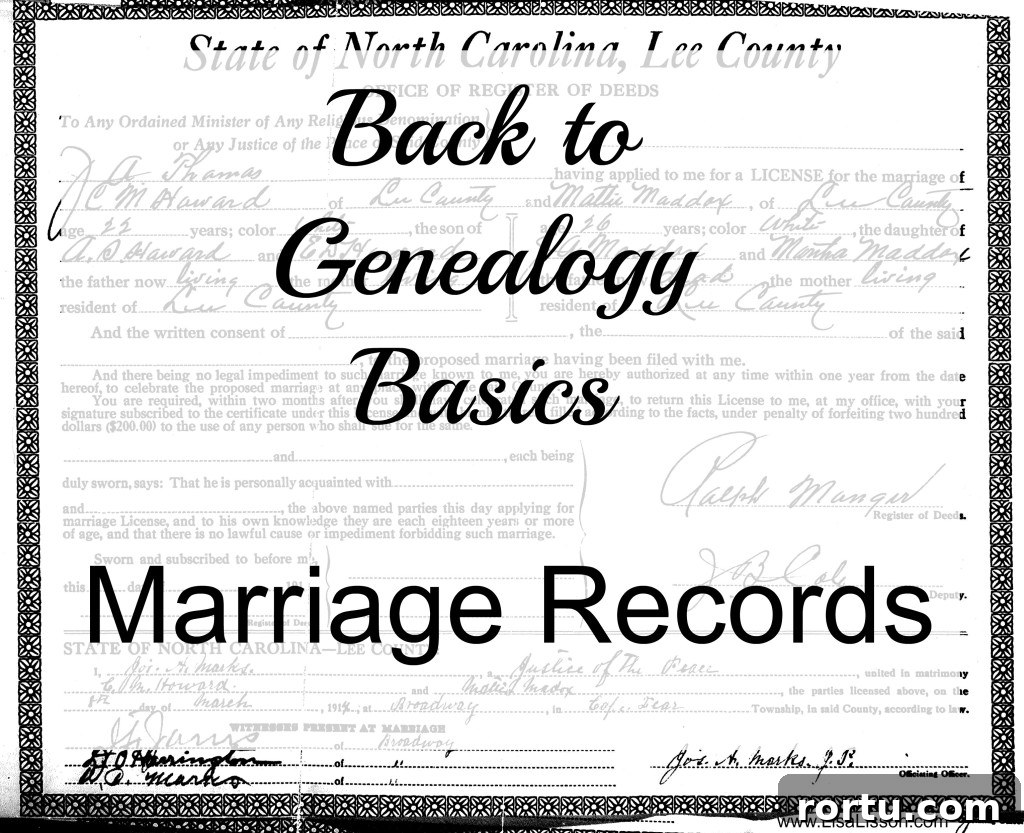
The following example is the marriage certificate of Connie M. (Harward/Howard) and Mattie Maddox of Lee County, North Carolina. Key details to extract and how to use them:
- Groom’s name — Often initials appear (C. M. for Connie M.). Record full names when available and note variants (Harward vs. Howard).
- Bride’s name — Mattie Maddox; record spelling and any variations.
- Residence — Lee County, North Carolina. Residence points you to local records, censuses, and land or probate files in that county.
- Ages — From ages listed you can estimate birth years (groom circa 1892; bride circa 1888). Use ages as approximations and confirm with other sources.
- Date of marriage — 8 March 1914. This anchors events and helps locate subsequent records like censuses and death records.
- Groom’s parents — A. S. Harward and E. D. Harward. Note that the mother’s maiden name may be omitted on some certificates.
- Bride’s parents — J. A. Maddox and Martha Maddox. Parents’ names often lead to earlier generations through birth, marriage, and probate records.
- Parents living or deceased — The certificate may indicate whether parents were living at the time; here, both of the groom’s parents were living, the bride’s mother was living, and the bride’s father was deceased. If a parent is deceased, search wills, estate records, and probate files for further information.
- Officiant — J. A. Thomas. The officiant’s name and the marriage location can identify the church or denomination associated with the family, opening another line of records such as membership lists, baptismal records, or church minutes.
- Location of marriage — Broadway, Cape Fear Township, Lee County, NC. The place of event narrows geographic searches in local archives and newspapers.
- Witnesses — Witnesses frequently are relatives or close associates and form part of an ancestor’s FAN (Friends, Associates, Neighbors). Track them because your ancestor may appear in their records as well.
Let’s Take a Look at a Marriage Bond
Marriage bonds document an intent to marry and were commonly used until about 1868. A bond establishes the parties involved, the bondsman (often a relative or close friend), the date, and the locale. While a bond does not guarantee the marriage took place, it still places the couple in a specific time and place and identifies their associates.
Example highlights from an 1828 bond:
- Groom — Burgess Woods
- Bondsman — Curtis Segraves (typically a supporter or guarantor, often kin)
- Location — Ashe County, NC
- Bond date — 2 Nov 1828
- Bride — Machen Seagraves
- Signatures — The groom’s original signature and the bondsman’s mark; signatures can aid in confirming identity and literacy
- Witnesses — e.g., Geo [Bowen], another likely associate or relative
Other Sources of Marriage Records
- Family Bibles — Families often recorded births, marriages, and deaths in family Bibles. These can be invaluable when civil or church records are missing.
- Church records — Baptism, membership, and marriage registers kept by churches frequently hold details not found in civil records.
- Newspapers — Local newspapers’ society pages, marriage announcements, and reports of wedding events or visitors can supply dates, locations, family names, and social connections.
Share Your Finds
Have you discovered marriage records in unexpected places? Document unusual sources, transcribe the details, and compare them with county, church, and archival records to build a fuller picture of your ancestors. Share interesting discoveries with fellow researchers to help expand collective knowledge.