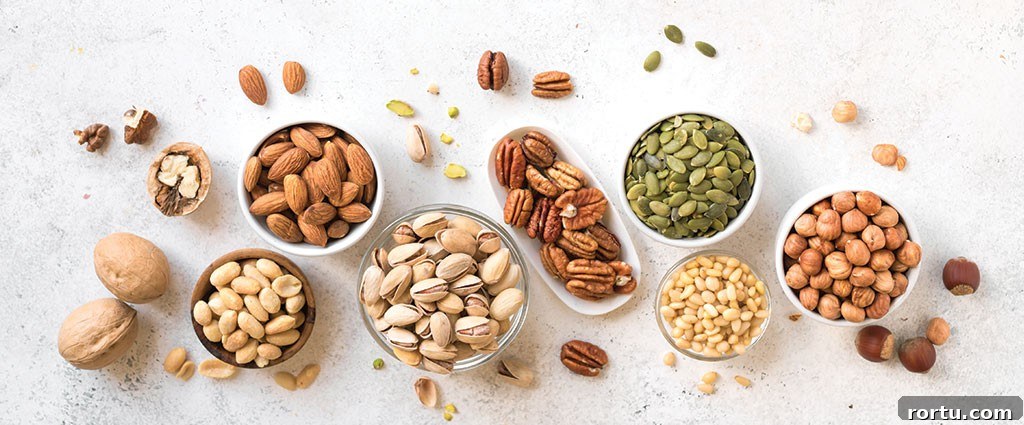
It’s a proven fact: all nuts are good for you. They deliver healthy fats, fiber, protein and an array of vitamins and minerals. But just as every superhero has unique strengths, each nut variety brings its own nutritional superpowers—specific nutrients that offer distinct health benefits.
Below is a concise guide to what six common nuts contribute to a healthy diet.
Peanuts
Peanuts provide more protein than any other nut—about 7 grams per one-ounce serving—making them a strong option for people following plant-based diets. They are also high in folate, important for DNA synthesis and fetal development, and niacin, a B vitamin that supports heart and brain health.
In a one-ounce serving, peanuts typically deliver 7 grams of protein, 10–17% of the daily value (DV) for folate (depending on processing), and 17–19% DV for niacin. That same serving supplies roughly 10% of daily fiber and 9–16% DV of copper. Nearly 90% of the fat in peanuts is unsaturated, the type associated with heart health.
Pistachios
Research indicates pistachios are among the richest food sources of melatonin, a plant compound that supports healthy sleep cycles. Pistachios also stand out for vitamin B6, which benefits the heart, brain, eyes and mood, and for lutein and zeaxanthin, carotenoids linked to eye health.
One study reported about 660 nanograms of melatonin per gram of pistachios, higher than most other foods. A one-ounce serving typically supplies 18–24% DV of vitamin B6 and 18–22% DV of copper in each serving.
Walnuts
Walnuts are unique among nuts for their high content of the plant-based omega-3 fat alpha-linolenic acid (ALA), which supports heart health. Some research has also linked higher ALA intake from walnuts with improved markers of male fertility.
A one-ounce (¼ cup) serving of walnuts contains about 2.5 grams of ALA and nearly half the DV for manganese. Walnuts also provide roughly 4 grams of protein, 22% DV of copper and measurable amounts of melatonin, which may contribute to sleep quality.
Cashews
Cashews are especially rich in copper, a mineral important for blood cells, connective tissue, immune function, nerves and bone health. They also supply more iron than many other nuts and are among the highest in vitamin K, which supports bone health and normal blood clotting. Cashews are comparable to almonds in magnesium content, a mineral vital for heart and bone health.
Each one-ounce serving of cashews provides nearly a third of the daily copper requirement, about 12% DV of vitamin K, 18–20% DV of magnesium and 9–10% DV of iron. Some research suggests cashews may contain fewer calories than typical label estimates.
Pecans
Often associated with desserts, pecans are nonetheless a nutritious choice. They are the highest tree nut source of manganese, a mineral essential for metabolism and bone health. Pecans are also low in carbohydrates relative to other nuts and are rich in monounsaturated fats—the heart-friendly fat profile.
A one-ounce serving of pecans supplies about 63% DV of manganese, roughly 11.4 grams of monounsaturated fat, 11% of daily fiber needs and about 12% DV of thiamine, a B vitamin important for nervous system function.
Almonds
Almonds rank high among tree nuts for vitamin E, calcium and B vitamins like riboflavin and niacin, making them a nutrient-dense snack. They are also one of the top food sources of vitamin E, which supports the immune system, skin and eyes. Almonds contain more fiber than most other tree nuts and provide meaningful magnesium, a mineral linked to blood pressure regulation and protection against type 2 diabetes and bone loss.
A one-ounce handful of almonds delivers nearly 40% DV of vitamin E, about 20% DV of magnesium, 17% DV of riboflavin and around 7% DV of calcium. That serving also provides about 6 grams of plant protein, 4 grams of fiber and 9 grams of monounsaturated fat, making almonds a satisfying and nutritious snack choice.